 |
| Image: VCU DST |
Friday, April 13, 2012
Ch. 11: The Media Production Process, Phase I

Ch. 10: Other Kinds of Stories
I completely agree with Ohler's statement about using music videos as a source for students to find inspiration for their own personal DST (pg. 128). With the abundance of videos on youtube, students would be able to gather many ideas to use towards production of their digital stories.
Providing or modeling examples is an important teaching practice for all ages. For our current Culminating Experience proposals for EDTE 299, it was extremely beneficial for me to to have access to previous iMet students' proposals; the examples provided a template to help me organize my plan. Seeing the variations of how students put together their proposal gave me confidence to make adjustments accordingly.
Although this youtube video is not the original music video for Ingrid Michaelson's "The Way I Am," there were some creative features that could potentially be used for my own personal DST. I liked how the creator divided the screen into three parts to show sequence of action shots.
Providing or modeling examples is an important teaching practice for all ages. For our current Culminating Experience proposals for EDTE 299, it was extremely beneficial for me to to have access to previous iMet students' proposals; the examples provided a template to help me organize my plan. Seeing the variations of how students put together their proposal gave me confidence to make adjustments accordingly.
Although this youtube video is not the original music video for Ingrid Michaelson's "The Way I Am," there were some creative features that could potentially be used for my own personal DST. I liked how the creator divided the screen into three parts to show sequence of action shots.
 |
| Screen shot from youtube video |
Ch. 9: More Story Maps
"My hope is that if the visual portrait of a story (VPS) doesn't work for you, something else will" (Ohler, 2008, pg. 113).
Ohler's reassuring opening words says it all.
As Christina mentioned in her blog, many of the ideas presented in this chapter (and book) can be easily adapted to my classroom instruction. I really appreciated this chapter because I immediately thought about how certain story maps would help certain students in my classroom.
For those visual learners like myself, I immediately made a connection with the Simplified Joseph Campbell Map because of the circular shape (Fig. 9.2, pg. 115). The idea about how a character begins at one "place," and transforms as he/she travels along the journey to finally "[come] full circle" home (pg. 115) made the most sense to me in terms of creating a story based on this model.
Non-linear thinkers who appreciate "a more free-form approach to story mapping" might gravitate towards the Treasure Map (Fig. 9.3, pg. 116) or the Adapted Story Map model (Fig. 9.4, pg. 117) because it would allow these students to "more accurately represent the action of [their] story" (pg. 116). The ranging peaks and "reversals" remind me of how some of students might describe the action of their story. These students may be my more "creative" students who don't like to follow the straight path like of the Aristotle Story Map (fig. 9.1, pg. 114). I myself also would find it difficult to match the action of my story using the direct line, and I would prefer to create the path accordingly (with many ups and downs).
Lastly, my English Learners (ELs) would greatly benefit from The Story Spine (Fig. 9.7, pg. 121) because of the sentence starters that sets up the most important parts of a story. EL students can even draw a picture to describe the action if they are unable to write it clearly. Ohler also described how he used this story map as an oral activity to create good stories which also would help my EL students develop better language skills. I think this model would also help students write summaries of the stories that they've read in class as well. With more practice of summarizing stories, eventually they would be able to create their own story!
Ohler's reassuring opening words says it all.
As Christina mentioned in her blog, many of the ideas presented in this chapter (and book) can be easily adapted to my classroom instruction. I really appreciated this chapter because I immediately thought about how certain story maps would help certain students in my classroom.
For those visual learners like myself, I immediately made a connection with the Simplified Joseph Campbell Map because of the circular shape (Fig. 9.2, pg. 115). The idea about how a character begins at one "place," and transforms as he/she travels along the journey to finally "[come] full circle" home (pg. 115) made the most sense to me in terms of creating a story based on this model.
Non-linear thinkers who appreciate "a more free-form approach to story mapping" might gravitate towards the Treasure Map (Fig. 9.3, pg. 116) or the Adapted Story Map model (Fig. 9.4, pg. 117) because it would allow these students to "more accurately represent the action of [their] story" (pg. 116). The ranging peaks and "reversals" remind me of how some of students might describe the action of their story. These students may be my more "creative" students who don't like to follow the straight path like of the Aristotle Story Map (fig. 9.1, pg. 114). I myself also would find it difficult to match the action of my story using the direct line, and I would prefer to create the path accordingly (with many ups and downs).
Lastly, my English Learners (ELs) would greatly benefit from The Story Spine (Fig. 9.7, pg. 121) because of the sentence starters that sets up the most important parts of a story. EL students can even draw a picture to describe the action if they are unable to write it clearly. Ohler also described how he used this story map as an oral activity to create good stories which also would help my EL students develop better language skills. I think this model would also help students write summaries of the stories that they've read in class as well. With more practice of summarizing stories, eventually they would be able to create their own story!
Thursday, April 12, 2012
Ch. 8: Transformation Formation
 |
| Image: Updated Bloom's Taxonomy |
Ohler advises teachers to help students create successful stories by asking questions to motivate character development to fulfill each level (pg. 111), which seem extremely productive. This method connected with my district's expectation of developing higher order thinking skills. Since asking more questions at the higher levels result in higher order thinking, does this mean that a story is not successful unless the character experiences transformation at highest level of evaluation/creating??
Saturday, April 7, 2012
Ch. 7: Story Planning Considerations
The plethora of tips and techniques Ohler presented in chapter 7 to prepare students in story planning were very useful to incorporate in my current teaching practices. The author claimed that "part of the art of writing a good story is limiting what is included so that a focused, coherent narrative emerges..." (pg. 98). His point resonated with me because I usually pay attention to what parts students are leaving out of their writing instead of what is really needed. As I mentioned in my previous entry, my students constantly practice how to make their sentences longer by adding more details. Also, in their weekly response to literature prompts or reading logs, I often remind students if they've added enough details to support their answers. Looking at writing from Ohler's perspective, it's important to brainstorm all the possible ideas but not necessary include all the details within the story. This concept has changed my view on what important details to consider while engaging in any type of writing.
 The research box diagram that the author provided to support students with their story ideas is very useful since my students are currently writing research reports at school. I can immediately integrate this tool within my classroom practice by having students write down the important ideas for their writing that might work for the report, or ideas that are related but not crucial to the report. Ultimately, regardless of how stories are created, Ohler's multiple strategies to consider while story planning provide a map that will guide students to reach the end result--a successful story.
Ch. 6: Applying Story Maps
I found this chapter extremely helpful by the way Ohler integrated the oral story of William Tell and the questions he'd ask to make sure the components of the story core were fulfilled. As I mentioned in my last blog entry, students must understand what the story core is about before a successful story can occur. I would need to investigate further on how to teach story core more effectively since Ohler failed to do so. However, after my students understand "the hero's journey" concept, I would definitely integrate the author's model of telling an incomplete or simple story and asking my students how we could improve it so that the story core is complete.
I often use Ohler's model of starting with a simpler idea and asking questions to add more details with my students' weekly spelling sentences. Students would share their sentence to their partner, and partners would ask the basic questions of who, what, where, when, why, and how to extend the sentence. Students practice this exercise every week to build better complex sentences. I think following Ohler's example of extending a simple story with story core as the basis every week would help students develop better stories.
Lastly, the title of this chapter clearly explained the purpose of using story maps to tell a story, but I found the moral of the chapter extremely interesting. The message of the William Tell story and how he shouldn't underestimate the talent of a young girl who knew something he didn't resonated with me because many of my colleagues are afraid of using technology in the classroom. I think Ohler wanted to make a point to teachers to not be scared (of incorporating DST) because they can always ask their students for help if they need it.
I often use Ohler's model of starting with a simpler idea and asking questions to add more details with my students' weekly spelling sentences. Students would share their sentence to their partner, and partners would ask the basic questions of who, what, where, when, why, and how to extend the sentence. Students practice this exercise every week to build better complex sentences. I think following Ohler's example of extending a simple story with story core as the basis every week would help students develop better stories.
Lastly, the title of this chapter clearly explained the purpose of using story maps to tell a story, but I found the moral of the chapter extremely interesting. The message of the William Tell story and how he shouldn't underestimate the talent of a young girl who knew something he didn't resonated with me because many of my colleagues are afraid of using technology in the classroom. I think Ohler wanted to make a point to teachers to not be scared (of incorporating DST) because they can always ask their students for help if they need it.
Ch. 5: Thinking About Story
My favorite storyteller was my former principal--she had the knack of "commanding the listeners' attention from beginning to end" (pg. 71) with her great sense of humor, and "[we] couldn't wait to hear what [would] happen next" (pg. 70) as she described stories of past students or weekend mishaps. My colleagues and I would spend our lunches laughing or crying (from laughing so hard) listening to her wonderful stories.
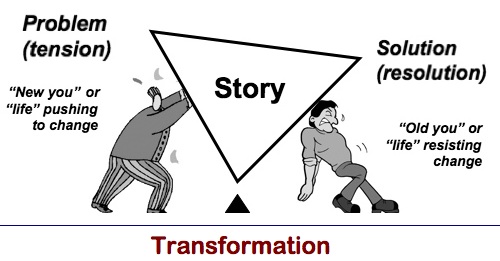
According to Ohler, such great storytelling traits are the necessary components needed to be a great storyteller. He acknowledgeed that there is not special formula, but important guidelines to follow when creating a wonderful story. From my understanding of this chapter, the author suggested starting with the story core, followed by the storyboard (which identifies the specific events-for media-based project purposes), which then finally leads to the development of a story map. I found Ohler's explanation of the story core extremely significant compared to the other parts because the basis of a successful story depends on the understanding of the story core model. The text describes the story core as "the journey that the hero takes [which] consists of of particular stages, including being called to adventure, denying the call, accepting a guide to help navigate the journey, passing tests, transformation, and return" (pg. 71). Conceptual understanding of the story core is crucial, but in my experience, a very complicated idea to teach.
As 6th graders, my students should already understand the ideas of the "story core" because of their experience in the primary grades where read aloud times are more prevalent. Although I love reading aloud to my students, other subject areas often take precedent. Thus, my students should know "the hero's journey," but I don't think many students do understand it. Many of my students were successful in explaining the beginning, middle, and end (something they've done for years) in their personal narratives writing assignment, but struggled to identify or explain the essential change or transformation of self to find a solution that resolves the tension (pg. 72). Although Ohler's Chapter 6 offers some facilitation for teachers to help their students develop the story core, more support is needed from the teacher's standpoint. As a newer teacher, I'm still learning how to be a better teacher. Thus, specific examples of how story core can be adapted to be humorous or serious would be most beneficial.
Although Ohler makes an ardent point regarding the use of story core "at the beginning of a DST project [to help] students focus..." (pg. 73), teachers have to make sure that their students understand the idea of story core before any good storytelling can occur.
According to Ohler, such great storytelling traits are the necessary components needed to be a great storyteller. He acknowledgeed that there is not special formula, but important guidelines to follow when creating a wonderful story. From my understanding of this chapter, the author suggested starting with the story core, followed by the storyboard (which identifies the specific events-for media-based project purposes), which then finally leads to the development of a story map. I found Ohler's explanation of the story core extremely significant compared to the other parts because the basis of a successful story depends on the understanding of the story core model. The text describes the story core as "the journey that the hero takes [which] consists of of particular stages, including being called to adventure, denying the call, accepting a guide to help navigate the journey, passing tests, transformation, and return" (pg. 71). Conceptual understanding of the story core is crucial, but in my experience, a very complicated idea to teach.
 |
| Image: Jason Ohler website. |
Although Ohler makes an ardent point regarding the use of story core "at the beginning of a DST project [to help] students focus..." (pg. 73), teachers have to make sure that their students understand the idea of story core before any good storytelling can occur.
Subscribe to:
Posts (Atom)